Introduction
If you have recently paid for Netflix, renewed a ChatGPT subscription, purchased cloud storage, or paid for software from a foreign company, you may have heard about Ghana's new 20% digital services tax collection system.
The announcement has raised questions among consumers. Will subscriptions become more expensive? Will banks deduct an additional 20% whenever we pay for an international digital service? And why are these charges being introduced now?
The answers require a little background.
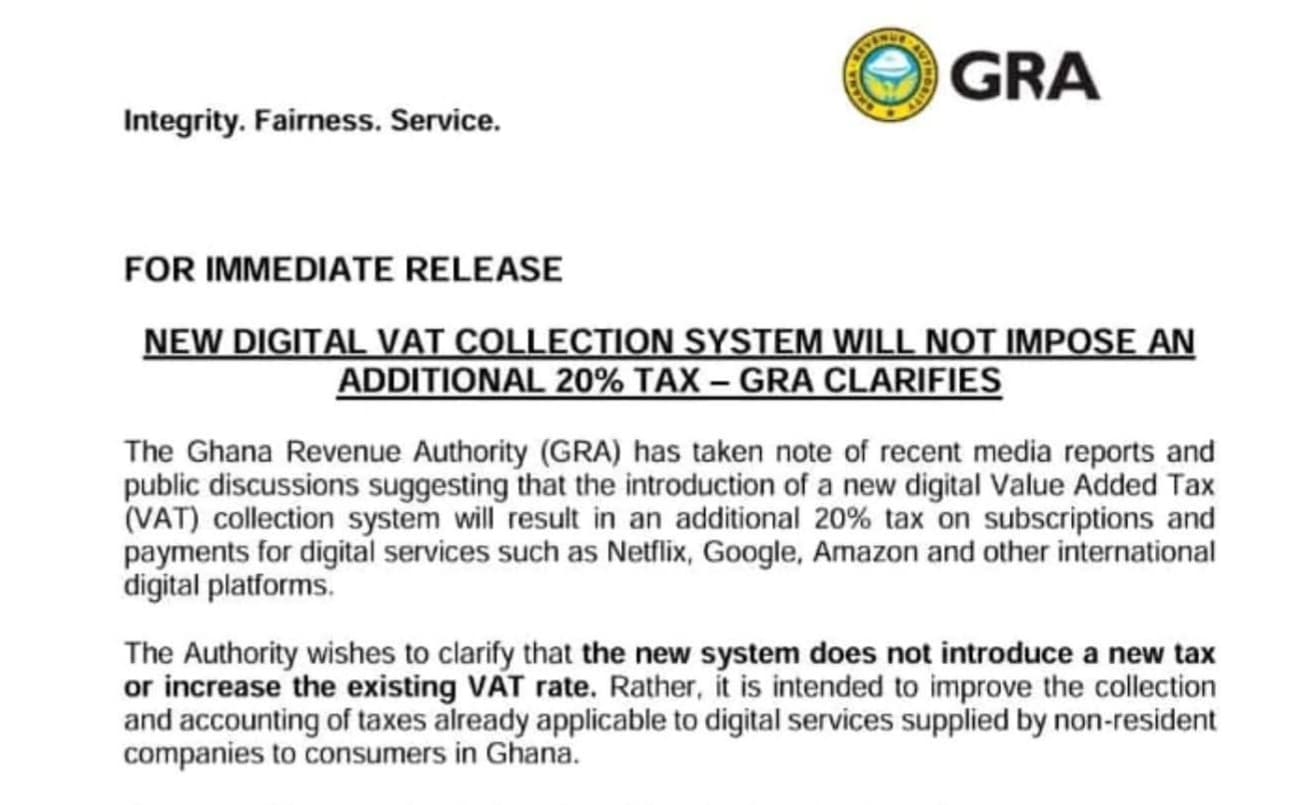
Ghana has had provisions in its tax laws requiring foreign businesses to account for VAT on certain digital services supplied to consumers in the country. What has changed is how the Ghana Revenue Authority (GRA) intends to collect and account for these taxes.
Under the new arrangement, the tax component of qualifying transactions will be identified and collected at the point of payment through participating financial institutions and payment service providers.
The distinction matters because a change in how an existing tax is collected is not necessarily the introduction of a new tax. However, consumers who have not previously been paying the applicable taxes on particular services may notice a difference in what they are charged.
To understand what this means for your subscriptions, it helps to look at how Ghana arrived at this point.
1. The Background: How Did Digital Services Become Taxable in Ghana?
The internet has changed how businesses sell products and services across national borders.
Today, a company does not need a physical office in Ghana to sell a subscription to someone living in Accra, provide cloud storage to a business in Kumasi, or offer an online application to a customer in Tamale.
A consumer can purchase these services from a company operating thousands of kilometres away, pay electronically, and begin using the service almost immediately.
This creates a challenge for tax authorities. How should a country collect consumption taxes on services supplied by businesses located outside its borders?
Ghana's legal framework addresses this issue through provisions governing electronically supplied services.
The Value Added Tax Act, 2013 (Act 870), established the legal basis for applying VAT to electronic services supplied by non-resident providers for use or enjoyment in Ghana. The Ghana Revenue Authority's guidance identifies services such as website supply, web hosting, digital content, music, games, databases and distance learning within the scope of electronic services.
The underlying principle is straightforward: a service does not necessarily escape Ghana's consumption tax rules simply because the company supplying it operates from another country.
However, having a legal obligation and successfully collecting the tax are two different things.
A tax authority must be able to identify the transactions involved, determine which businesses have tax obligations, and ensure that the applicable amounts are declared and paid.
That is where the administration of cross-border digital services becomes more complicated.
Source: Ghana Revenue Authority — E-Commerce and Electronic Services VAT.
2. The 2022 Development: Bringing Foreign Digital Providers Into the Tax System
Ghana subsequently moved to formalise the registration and compliance of non-resident businesses supplying electronic services to consumers in the country.
From 2022, foreign digital service providers were being brought into the VAT registration and collection framework. This required affected businesses to account for the applicable taxes on qualifying supplies to customers in Ghana.
The change reflected a wider challenge facing tax authorities around the world: consumption increasingly takes place through digital services that can be supplied across borders without a traditional physical presence in the customer's country.
Consider a Ghanaian customer paying for a streaming subscription from a foreign company.
The customer lives in Ghana, pays for the service, and uses it in Ghana. However, the company supplying the subscription may operate from another jurisdiction.
Under the applicable rules, the foreign supplier may have an obligation to register with the GRA, account for the tax due, and remit it to the Authority.
This arrangement allows the tax to be administered through the supplier rather than requiring every individual consumer to calculate and declare the tax on every subscription payment.
Over time, a number of foreign digital service providers registered with the GRA and began remitting the applicable taxes.
Nevertheless, not every provider necessarily complied in the same way or to the same extent.
The GRA has acknowledged that it continues to identify foreign digital service providers that are not charging and remitting the required taxes. Its October 2026 clarification indicated that approximately 92 non-resident digital service providers were registered and remitting VAT, while about 100 additional providers had been identified for progressive compliance.
These figures help explain why the existence of a legal obligation does not automatically guarantee that every qualifying transaction is taxed correctly.
Sources: GRA — E-Commerce and Ghana News Agency — Digital VAT system will not impose additional tax.
3. Why Is Ghana Changing the Collection System?
Under the previous arrangement, the GRA relied substantially on foreign digital service providers to identify their taxable transactions, declare the applicable taxes and remit the amounts due.
That approach depends on providers meeting their obligations and on the tax authority being able to verify the information submitted.
When a provider does not register, fails to account for qualifying transactions, or does not remit the correct amount, the tax authority faces a collection and compliance challenge.
This is particularly relevant in a digital economy where transactions can take place automatically, across borders, and in large volumes.
The GRA's new Real-Time VAT (RTVAT) framework is intended to strengthen this process by introducing a mechanism for identifying and collecting the tax component of qualifying payments when those payments are made.
The new system is associated with the Sentinel technology used to support the collection process.
Instead of relying solely on a foreign provider to declare and remit the tax, the system enables participating financial institutions and payment service providers to identify the applicable tax component of qualifying transactions and route it for remittance to the GRA.
The stated objective is to improve compliance, transparency and accountability.
It is also intended to address a difference in how domestic and foreign businesses may experience tax compliance. A Ghanaian business required to charge and remit VAT cannot simply ignore that obligation because it sells its services locally. The GRA argues that foreign providers supplying qualifying services to Ghanaian consumers should also meet their applicable tax obligations.
The new mechanism is therefore a change in tax administration: it seeks to make collection more systematic and less dependent on voluntary reporting by overseas providers.
Sources: Ghana Revenue Authority's clarification, reported by GNA and Graphic Online — Same tax, smarter collection.
4. What Exactly Is the 20% Tax Made Up Of?
The 20% figure has become the centre of public discussion, but it is important to understand what it represents.
The applicable effective rate comprises three components:
| Tax or levy | Rate |
|---|---|
| Value Added Tax (VAT) | 15% |
| National Health Insurance Levy (NHIL) | 2.5% |
| Ghana Education Trust Fund (GETFund) Levy | 2.5% |
| Total | 20% |
These are the components identified by the GRA in its October 2026 clarification.
The VAT and levies apply according to the relevant tax legislation and the nature of the transaction. They should not be confused with a separate, newly introduced 20% tax created by the latest collection announcement.
For a simple illustration, suppose a qualifying digital service costs GH₵100 before the applicable taxes.
If all three components apply to that amount, the calculation would be:
| Item | Amount |
|---|---|
| Service price before tax | GH₵100 |
| VAT at 15% | GH₵15 |
| NHIL at 2.5% | GH₵2.50 |
| GETFund Levy at 2.5% | GH₵2.50 |
| Total payable | GH₵120 |
The example illustrates the arithmetic. It does not mean every subscription will necessarily cost 20% more following the introduction of the new collection mechanism.
Whether a consumer sees a price change depends on factors including whether the applicable taxes were already being charged, how the provider displays its prices, and how the transaction is processed under the new arrangement.
That distinction is central to understanding the announcement.
5. How Will the New Collection System Work?
Under the new framework, the tax component of a qualifying transaction is identified and collected through participating financial institutions and payment service providers.
The system is intended to cover qualifying electronic services supplied by non-resident businesses and paid for through Ghana-issued payment instruments.
These may include bank cards, mobile money accounts and other eligible digital payment platforms.
For example, imagine that a customer in Ghana pays for a subscription to an online service operated by a company based abroad.
The customer initiates the payment using an eligible Ghana-issued payment instrument. If the transaction meets the relevant conditions, the collection system identifies the applicable tax component.
The tax amount is then separated from the payment and routed for remittance to the GRA, while the remaining amount is paid to the service provider.
The intended result is that the applicable tax can be collected and accounted for at the point of payment rather than relying entirely on the foreign supplier to declare and remit it later.
The system does not mean that every international payment automatically attracts this 20% charge. Its application depends on the transaction meeting the relevant conditions, including the nature of the service, the status of the supplier and the payment instrument used.
It is also important to distinguish digital services from physical goods. The GRA has clarified that this collection framework concerns qualifying digital services, while imported physical goods remain subject to the applicable customs procedures.
Source: Ghana Revenue Authority's clarification, reported by GNA.
6. Which Online Services Could Be Affected?
The framework concerns qualifying electronically supplied services from non-resident providers. Depending on the nature of the transaction, these may include several categories of services familiar to Ghanaian consumers and businesses.
Streaming and entertainment
Subscriptions to services such as Netflix, Spotify and other international streaming platforms may fall within the scope of the rules.
These services supply digital entertainment to customers without requiring the provider to operate a traditional physical outlet in Ghana.
Artificial intelligence and productivity tools
Paid subscriptions to AI tools, office applications, design software and online collaboration platforms may also be covered where the relevant conditions are met.
Examples include ChatGPT, Microsoft 365, Adobe and Zoom.
Cloud computing and hosting
Businesses and developers often pay overseas providers for cloud infrastructure, hosting, storage and other computing services.
These subscriptions can support websites, applications, databases and business systems. Qualifying services supplied by non-resident providers may fall within the framework.
Digital advertising
Businesses purchasing advertising through international platforms may also need to consider the applicable tax treatment.
Digital advertising is particularly relevant to businesses that pay to promote their products and services to customers online.
Other online services
Online gaming, distance learning and other electronically supplied services may also be covered, depending on the service and the transaction.
These examples are not a definitive list of every taxable service or transaction. The precise treatment depends on the applicable rules and the circumstances of the supply.
The important point is that the framework is not limited to entertainment subscriptions. It can also affect the digital tools and infrastructure used by professionals, developers, freelancers and businesses.
7. Will Netflix, ChatGPT and Other Subscriptions Become 20% More Expensive?
This is probably the most immediate question for consumers.
The short answer is: not necessarily.
The GRA has stated that consumers already paying the applicable taxes should not be charged again on the same transaction simply because the collection mechanism has changed.
Suppose a service already charges the applicable taxes as part of its subscription price. Under the new arrangement, the introduction of payment-level collection should not result in the same taxes being imposed a second time on that transaction.
However, the situation may differ for a provider that has not previously been charging and remitting the applicable taxes.
If the tax was legally due but was not being collected from the customer, bringing that provider into compliance could cause the tax to appear in the customer's payment.
That may increase the amount the customer pays compared with what they previously paid.
The distinction is therefore between an additional tax being introduced and an existing tax being collected where it was not previously charged.
For consumers, the practical question is not simply whether a subscription is foreign. It is whether the applicable taxes were already included in the amount paid and how the provider and payment intermediary implement the new system.
Consumers should review their subscription invoices, billing statements and bank or mobile money transaction records to understand what they are being charged.
If a payment appears to include a duplicate tax charge, the customer should seek clarification from the provider, bank or payment service provider and, where necessary, the GRA.
8. What Does This Mean for Freelancers, Developers and Businesses?
The implications extend beyond personal entertainment subscriptions.
Many people and organisations rely on foreign digital services to participate in the modern economy.
A software developer might pay for cloud hosting, development tools, APIs or AI services. A freelancer might subscribe to design software or an online collaboration platform. A small business might purchase cloud storage, business software or digital advertising.
For these users, the cost of digital services can form part of the operating expenses required to earn an income or deliver a service.
Where applicable taxes were not previously being charged, bringing a provider into compliance may increase the cost of the subscription or service.
Businesses should therefore review their recurring digital expenses and account for any applicable taxes when planning their budgets.
They should also retain invoices and payment records and seek appropriate tax advice where the treatment of a particular service is unclear.
The new system does not necessarily mean every business will face higher costs. The effect will depend on the services purchased, their existing tax treatment and the relevant rules.
Nevertheless, the change highlights an important point: digital services are part of the economy's commercial infrastructure, and the tax treatment of those services can affect both household spending and business costs.
9. Why Is This Important for Ghana's Digital Economy?
The growth of digital services has created opportunities for consumers, professionals and businesses to access tools and infrastructure that were once more difficult to obtain.
A small business can use international cloud services without building its own data centre. A freelancer can subscribe to professional software from a foreign provider. A student can access online learning resources from anywhere with a suitable connection.
These services make it possible to participate in a global digital economy without requiring every supplier to establish a physical office in every country where its customers live.
However, that same cross-border model creates challenges for tax administration.
A tax authority must be able to apply the relevant rules to qualifying transactions, regardless of whether the service provider is based locally or abroad.
From the GRA's perspective, improving the collection of taxes already required by law supports compliance and helps ensure that foreign digital service providers meet their obligations.
For consumers, however, the system must also be implemented transparently. People need to understand why they are being charged, how the tax is calculated, and what to do if a payment appears to have been taxed incorrectly.
Clear communication and safeguards against duplicate collection will therefore be important to public confidence in the system.
10. What Should Consumers Do Now?
There is no need to assume that every online subscription will suddenly become 20% more expensive.
Instead, consumers can take a few practical steps.
Check your subscription invoices. Determine whether the applicable taxes are already included in the price you pay.
Review your payment records. When renewing a subscription, compare the amount charged with the provider's stated price and any applicable taxes.
Understand the distinction between the service price and tax. A provider may display a price before tax, while another may display a tax-inclusive amount.
Contact your bank or payment provider if something appears incorrect. Ask for an explanation of the tax component and the basis for the charge.
Seek clarification if you suspect duplicate taxation. The GRA has stated that the new arrangement should not cause customers already paying the applicable taxes to be charged again on the same transaction.
Businesses that depend on foreign digital services should also review their expenses and retain the relevant invoices and payment records.
Conclusion: An Existing Tax, a Different Collection Approach
Ghana's digital services tax collection changes are part of a broader effort to administer existing tax obligations in an economy where services increasingly cross borders electronically.
The legal foundation for taxing qualifying electronic services supplied by non-resident businesses dates back to the Value Added Tax Act, 2013. Subsequent implementation brought foreign digital providers into a registration and compliance framework, while the latest collection mechanism is intended to strengthen the process by identifying and collecting the tax component at the point of payment.
The effective rate identified by the GRA remains 20%, comprising 15% VAT, a 2.5% National Health Insurance Levy and a 2.5% GETFund Levy.
For consumers, the crucial distinction is whether the applicable taxes were already being charged. Those already paying them should not face duplicate taxation on the same transaction. Customers using services where the taxes were not previously collected may, however, notice a change in their payments.
Ultimately, understanding the announcement requires looking beyond the headline figure. The question is not simply whether Ghana is introducing a 20% tax on digital services, but how existing tax obligations are being enforced and what that means for people and businesses that depend on international digital platforms.
As the new system takes effect, clear billing, transparent communication and effective handling of disputed charges will be essential to ensuring that consumers understand what they are paying for.